

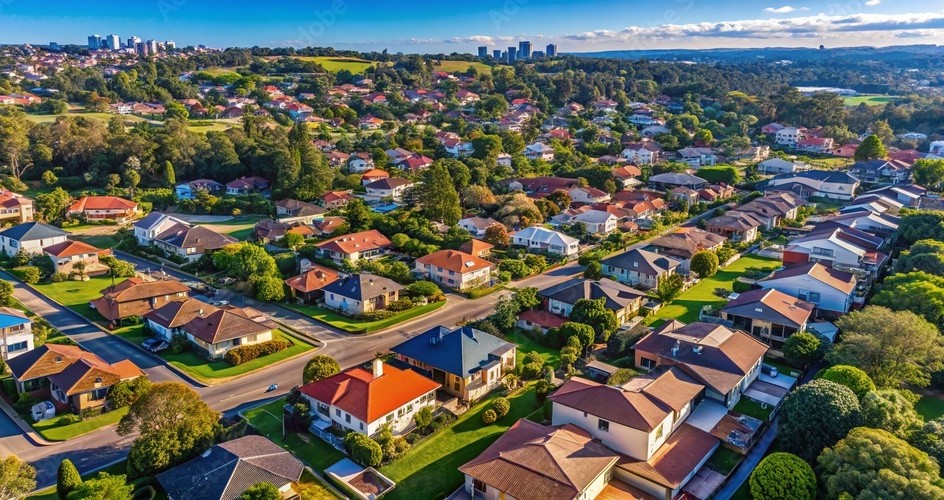
Featured Industry News
The NSW Government’s Planning System Reforms Bill 2025...
The Overlooked Corridor
Greater Sydney and its ‘near region’ extend from Newcastle to the Illawarra and Canberra. This corridor accounts for just over a quarter of the nation’s population, and is expected to grow by 1.5 million people over the next 20 years. Planning for the corridor is already well positioned to accommodate part of this growth, with the Central Coast first included in Greater Sydney’s planning over 50 years ago, and metropolitan plans for Greater Newcastle and Wollongong having commenced over a decade ago. However, the Sydney-Canberra corridor currently accounts for only 3 per cent of the overall projected growth in the Greater Sydney and near region area.
Unlike its coastal counterparts, the planning for the Sydney-Canberra corridor, which includes the Southern Highlands, has had limited attention. Since 2016, it has been included in the much wider planning region of the South East and Tablelands Region, which extends south to the NSW border. In December, the NSW Government released a discussion paper on strategic planning, proposing to split the corridor between Regional NSW and an expanded Illawarra-Shoalhaven Region, which will now include Wingecarribee LGA.
The economic and development opportunities of the Sydney-Canberra corridor have not been fully explored since the 2006 Sydney-Canberra Corridor Regional Strategy was abandoned. In 2006, it had been recognised as one of the fastest-growing inland areas in NSW.
The concept of ‘near regions’, which refers to areas within one to two hours of a major city, was recently put forward by demographer Bernard Salt. He emphasises the significance of ‘near regions’ in the context that they make up 25 per cent of the nation’s population, around 7 million people, thus a larger population than either Sydney or Melbourne. This warrants the requisite planning and development support to maximise their economic contribution.
Whilst the Canberra Plus 1 strategy does consider the surrounding population within one hour of the ACT, its focus is on managing growth in the ACT and cross-border issues. Hence, the economic and development opportunities of this ‘near area’ corridor of Sydney-Canberra have not been fully explored. This is despite the Southern Highlands Innovation Park (SHIP) being capable of accommodating more than 9,000 jobs and the urban cluster of Mittagong, Bowral, and Moss Vale being just 30 kilometres from the southwest edge of Greater Sydney. In addition, there is the strategic location in relation to infrastructure investments, including Western Sydney Airport, the proposed orbital roads, and a potential connection through to Port Kembla.
Housing challenges in the Southern ‘Near Region’
The NSW Government’s response to meeting the National Housing Accord targets for housing supply envisions 30 per cent of NSW’s supply to be outside Greater Sydney. However, there is not yet a framework to address the regional housing challenges and the importance of linking regional housing to economic development. House prices continue to rise across NSW, so the reliance on housing supply from higher-cost housing near train stations in metropolitan Sydney needs to be balanced with other feasible housing supply, such as housing in the ‘near regions’ that also have access to transport infrastructure.
The Wingecarribee LGA illustrates the severity of the challenge. Here, 40 per cent of renters are in housing stress, and affordability is worsening. Housing supply is constrained by a reliance on incremental growth of only around 300 new dwelling approvals a year. This results in record-high job vacancies in key worker sectors, while 20 per cent of workers face long commutes out of the LGA to Greater Sydney or the Illawarra for work.
This is creating what researchers refer to as a ‘demographic dependency crisis’ – producing one of NSW’s fastest growing retirement communities. The median age in the Southern Highlands is currently 48, compared to 38 in NSW overall. Without intervention, projections show that over the next 20 years, there will be an additional 4,300 retirement-age residents (65+ years), outnumbering the increase of.4,200 working-age residents (25-64 years).
The low-growth trajectory does not align with the economic opportunities available in this southern ‘near region’. Furthermore, ad hoc incremental growth can be detrimental over time and erode the quality and character of townships. The dispersed nature of incremental growth means that thresholds for new schools and community services are not met, putting strain on existing infrastructure.
Increased housing supply and greater housing diversity at a community scale are urgently needed to provide more affordable housing options that can retain and attract young workers and support investment in the corridor.
A Strategic Approach
The importance of delivering projects at scale, rather than the limited levels currently projected, is core to the United Kingdom’s recent ‘New Towns’ approach, where ‘scale, housing potential, location and strategic fit’ are the starting point for new developments. The significance of scale is evident in the southern part of the corridor at Ginninderra and Jerrabomberra, and in the northern part at Wilton and Appin. There is a clear rationale for adopting a City Corridor Network approach, inspired by the UK New Towns policy, to optimise outcomes that integrate jobs and housing along this key Sydney-Canberra infrastructure corridor.
The objective of integrating jobs, housing and infrastructure is also emphasised in the UDIA’s ‘Greenfield 2.0′ initiative, which has at its core the goal of creating communities, not just housing estates. The initiative also outlines the importance of leveraging existing intra-regional transport, delivering a mix of housing types, rehabilitating degraded riparian corridors, and integrating green, blue, and grey infrastructure to support shaded, pedestrian-friendly streets, all of which are achievable through the careful consideration of regional greenfield villages. Today, delivering new communities also enables the use of technology to support innovative transport options, such as on-demand bus services, funded through public-private partnerships.
The time has come to revisit this strategic opportunity for a ‘City Corridor Network’, following the recent release of Infrastructure Australia’s evaluation report for Stage 1 of the High Speed Rail (HSR), which, in line with past planning, focuses on accessibility and the Sydney-Newcastle corridor. The evaluation report includes a direction that the next phase of planning for HSR address “detailing the design and constructability expectations for access” to Canberra, as well as to Melbourne and Brisbane. This direction, together with the recent release of the draft Sydney Plan and Discussion Paper – A New Approach to Strategic Planning, emphasises the need to bring forward the investigation of development opportunities in the ‘near region’ of the Sydney-Canberra corridor.
Just as the Transport Oriented Development framework now underpins housing opportunities in Greater Sydney, a City Corridor Network approach could underpin a southern ‘near region’ greenfield program. Fundamental considerations, such as locations that are both within 15-30 minutes of a regional rail station and within 5 km -10km of the Hume Highway, and having the scale to deliver community outcomes, could be used to examine new greenfield village opportunities within the Sydney-Canberra corridor.
The National Housing Accord has highlighted the need for brave decisions that reflect the scale of the challenge of delivering housing and community outcomes. A corridor approach to well-located regional greenfield villages that respond to the opportunities of the southern ‘near region’ is a clear and realisable opportunity that will serve NSW well, now and into the future.
The NSW Government’s Planning System Reforms Bill 2025...
The NSW Department of Planning, Housing and Infrastructure...
The Queensland Government has opened public consultation...